
The main goal of developing Java was to make it portable, easy, and secure. On top of that, some exceptional elements play a significant role in the popularity of this language. Java features are also referred to as Java buzzwords.
The most significant features of Java are:
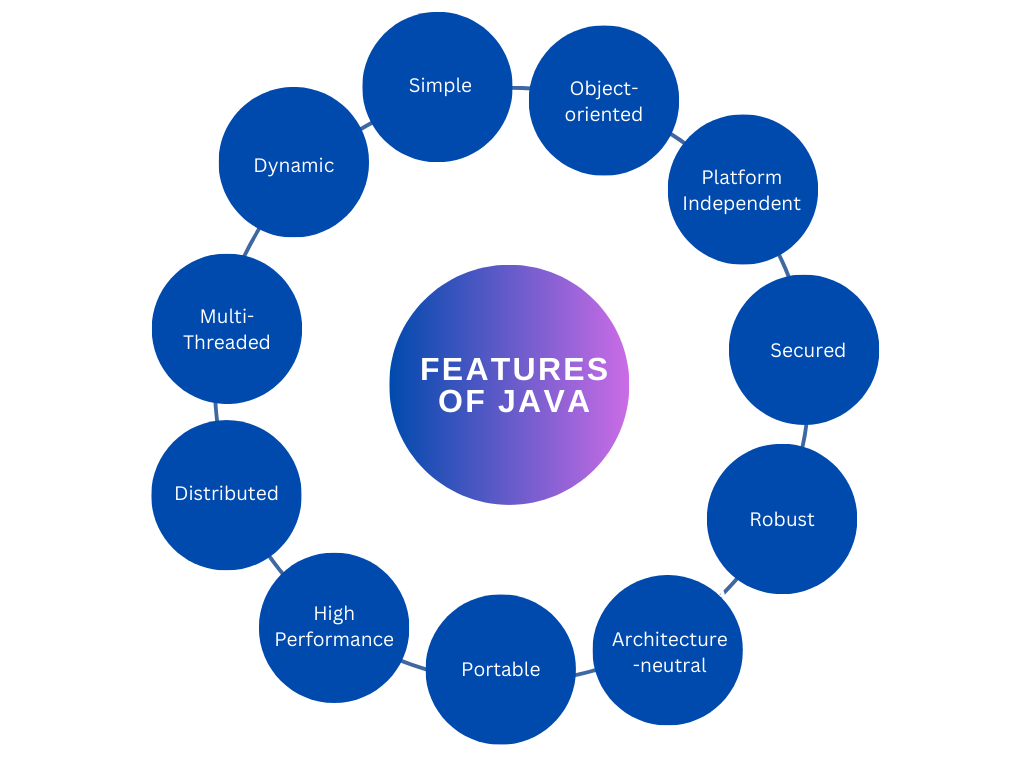
SIMPLE
Java is a concise, clear, and easy-to-understand programming language. As per Sun Microsystem, Java is a simple programming language because of the following reasons:
Its syntaxes are based on C++.
Java doesn’t use complicated and scarcely used features such as operator overloading, explicit references, and so on.
Automatic garbage collection automatically removes unreferenced objects.
OBJECT – ORIENTED
Java is an object-oriented programming language. In Java, everything is treated as an object. This implies that the software is organized as a collection of various kinds of objects that include both behavior and data.
Object Oriented Programming (OOPs) concept provides some principles that help in simplifying software development and maintenance. Some basic concepts of OOPs are:
Object
Class
Inheritance
Polymorphism
Abstraction
Encapsulation
PLATFORM INDEPENDENT
Java doesn’t depend upon the platform as compared to other programming languages like C, C++, etc. Java is a “write once, execute anywhere” program. Platform refers to either hardware or software which provides an environment to run programs. Java provides a software-based platform. What differentiates the Java platform from most of the other platforms is that the software-based platform runs on top of other hardware-based platforms. The components of the Java platform are Runtime Environment and Application Programming Interface (API).
SECURED
Security is one of the best features in Java. We can create virus-free applications with Java. Some of the reasons why Java is secure are:
Java Programs run inside a virtual machine sandbox.
There is no concept of the explicit pointer in Java.
Security Manager: Access rights to local disks, such as reading and writing in local disks are determined by this feature. Additional security can be provided by the developer explicitly through cryptography, JAAS, etc.
Bytecode Verifier: Bytecode verifier checks for illegal code fragments that may violate object access rights.
Classloader: Classloader in Java is used to load the Java classes into JVM dynamically. It also separates the package for the classes in the local file system from the classes imported from other network sources.
ROBUST
Java is a robust language because it uses strong memory management. Security problems are avoided as there are no pointers. The automatic garbage collection feature runs on JVM, this helps in getting rid of unreferenced objects in the application. There are proper exception-handling and type-checking mechanisms in Java which makes Java a robust language.
ARCHITECTURE-NEUTRAL
Java is an architecture-neutral language as it does not have any implementation-dependent features. For example, In C Programming, for 32-bit architecture, the int data type occupies 2 bytes whereas 4 bytes of memory for 64-bit architecture. But in Java, the size of the int data is 4 bytes for both 32 and 64-bit architectures.
PORTABLE
Java is compiled to an intermediary state known as bytecode. This bytecode is capable of running on any machine with the JVM installed which interprets it to native code and is executed. So Java is a portable language.
HIGH-PERFORMANCE
Since Java bytecode is similar to the native code, it is more efficient than other traditionally interpreted programming languages. But Java is an interpreted language and thus is slower than other compiled languages like C, C++, etc.
DISTRIBUTED
Java provides the user to create distributed applications using Remote Method Invocation (RMI) and Enterprise Java Bean (EJB). The files can be accessed from any machine on the internet by calling the methods provided by the RMI feature.
MULTI-THREADED
Java uses the concept of multithreading. Java programs can be written to deal with multiple tasks that can be executed concurrently. These tasks are called threads. Working on multithreading helps in strong memory management as each thread shares a common memory area. The major usage of multithreading concepts is in multi-media, Web-applications, etc.
DYNAMIC
Java supports the dynamic loading of classes and hence is called a dynamic language. This means the classes in the java application are only loaded into the memory once a method in the main class is invoked requiring the method in the classes. Java also supports automatic garbage collection (strong memory management) and dynamic compilation.